Thursday

Kazakhstan Poverty Research - Tuesday, Sep.5 (Day Six)


Tuesday September 5 (Day Six)

UNDP

We decided to visit UNDP as planned. Although there were some uneasy happenings to our side we thought that we would have done it under any circumstance. UNDP building was in the UN building complex with other UN agencies. We met two ladies in charge of poverty research and micro-credit scheme. When I mentioned the UNDP report on the poverty reduction programme in Kazakhstan, they said that the performance in Kazakhstan had not been that bad, which was a bit different from the report. When we finished the interview, they introduced us to the branch chief, Japanese lady and we had a kind of courtesy interview for about 10 minutes. I don:t know why, but she looked very much tired and did not seem to have an interest in our research.

Bazzaal

Wherever you go, if you don`t want to miss the most exiting and the most local, the place you have to go for is the local market. They call it Bazzal in Kazakhstan. It is the most bustling place in Almaty, of course and you can feel what the market would be like several centuries ago when there were all the merchants with camels whose back filled with silks and spices. We went to the Bazzal to buy small gifts for those we are going to have interviews in both Kyzylorda and Aralsk. It was Lyalya who told us that in this country, you are supposed to give small things when you visit them. We bought pencils, small notebooks and others. We were continuously warned about pickpockets who are as many as the number of merchants in the market and were not brave enough to look around the market. If you are fooled once, shame them. And if you are fooled again, shame on you. Although we successfully avoided shaming none of them but I felt shameful since I could not feel the vividness of the local market.

Lyalya`s Interview with International Migration Organisation

Yesterday Lyalya asked us to give her one or two hours for her job interview. When she graduated she sent two applications for the job and one of those two applications got the reply for the interview. The problem was she did not know what that organisation was exactly. She mentioned it is something beginning with I but that was all. Since the place was on the way to our hostel, we decided to drop Lyalya off that place. When we arrived that place, we were surprised to find that organisation was International Migration Organization. `Lyalya, this is very good international NGO and you must take the job` we said in one voice. Anyhow she entered building and we told her that we would be waiting for her until she finished the interview. While waiting I found out a good English-style pub and we took a rest drinking tea, coffee and juice. The result was successful. Lyalya was told to work from 20th for one month as a probation period. Actually the probation period was supposed to begin from tomorrow but it was turned out that Lyalya asked them to give her time to accompany us for the trip to Kyzylorda and Aralsk. It was a surprising asking a favour to them and us except Lyalya. She is into this research such an extent.

Kazakhstan Poverty Research - Monday, Sep.4 (Day Five)


Monday September 4 (Day Five)

Almati Office of Japanese Embassy

Drop by World Bank Information Centre

White Beer at Chin Koff

Kazakhstan Poverty Research - Sunday, Sep.3 (Day Four)


Sunday September 3 (Day Four)

Tenshyan Mountain

The Japanese Prisoners Cemetery

Silkway Shopping Mall

Kazakhstan Poverty Research - Saturday, Sep.2 (Day Three)


Relaxed Morning

The travel style of Koreans is described as Napoleon style. Majority of Korean holiday makers had to visit every places recommend in tour guide and that pressure makes them much busier and more tired during the holiday making. They take a photo instantly at the sight and move on to another spot for conquer. I am one of those Korean who are not respecting and following Napoleon`s `hoof steps` and really like the relaxed morning at hotel and time at the evening when I can think things I did during the day, read some books and write mails. The morning of the third day was exactly something I really like. We were supposed to start our business at 10:30 and I had enough time to organise many things. I wrote some notes and had a discussion with Mr Park. Mr Park provided me with a phone number of one Korean minister serving a church in Kyzil Orda and I made a call to him. He answered that he would be willing to help me. The great thing was he had a church member working for the statistics office in Kyzil Orda and we might have a chance to have an interview with her.

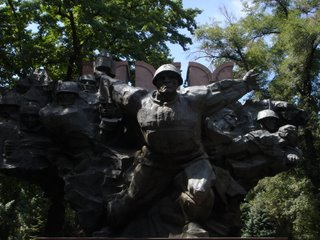
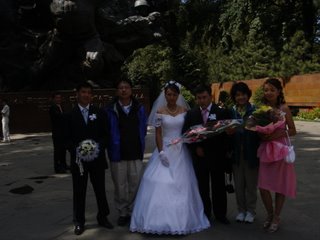
Picking up Lyalya, we headed for Musical Instrument Museum but it was closed for restoration. Just next to Musical Instrument Museum was the Memorial Park for 28 Patriots During the Second World War. 28 Kazakhs were dead fighting against Nazi Germany and the government established the memorial park for them. It was quite Soviet style where there was a gas torch, probably named like eternal torch or torch forever, just in front of big monument of those who were killed during the War, a typical socialist realistic statues. It seemed to be the most popular venue for newly wedded couple and we could see a lot of newly wedded couple. The couples and guests even invited strangely looking travellers for photo session and we took a picture of us with one of newly wedded couple like bestmen and bridemaids with those big statutes behind us. I wonder whether they think about those dead and the miseries of war. They seemed to be very happy and not think about all the pains even for a second. Well, it is true that they don:t have to think about the war which they will face several times in the future, at least now. May all the pains be Champagne!!

After memorial park we dropped by the book shop and music store. I bought maps and music CDs. Whenever I visited new places, the things I never miss to buy are maps, language books and music CDs. Those maps can give me a rough idea about where I am and language books may give me a wonderful chance to communicate with the locals and musics…they can do everything that I want to do. There were not language books for English speakers and I had to give up buying language books. I bought good map published by government`s land and water survey department and some CDs, traditional Kazakh musics and the most popular singers` among the youngsters. Listening to those musics at the store I found Kazakh musics are very mixture of Indian, Western and Mongols. What is this mixture by the way? Maybe that is Kazakhs.

The man with six nationalities.

It was from Professor Ishida whom I heard the story about Mr Kim Jong Hoon, political refugee from North Korea from. Prof. Ishida briefly talked about this gentleman whose life was deeply intertwined with the tragic history and I was so anxious to meet him and listen to his story. When preparing this research trip I had several phone calls with him but the connection was not that good and I could not talk much other than the arrangement for our trip. In the afternoon we visited Mr Kim`s house and listened to his turbulent life.
Mr Kim was born in Haeju in 1932. His father was educated in Waseda University and became a teacher in middle school in Haeju. When he was third year student the Korean War took place and they were told to participate in the war which, they said, would be finished very soon and come back to normal school life. He entered the cadet academy for the basic training for three months. About the time when he finished the training, General MacArther landed in Incheon and North Korean Army withdrew from the south. When he assigned as an offier of Artillery, the battle front was already in the North. He fought against the South Korea and UN for almost 2 years and after that he was assigned as a personal secretary for General Kim Jung Don, the chief of 8th Brigade. He got the credit from his boss and his boss opened the window of opportunity for him. He was selected as one of 50 students who would study abroad, which was the rare chance for all the students in 1953. Since his major was chemistry in the university, he wanted to study mathematics related to chemistry. The factor which decided his new major was not his academic background or ability but his height. When the allocation for the major began at the party office, He, the shortiest among the 50 students, was at the end of the line and the Party started allocating the major for students one by one. That was typical socialist way that I heard of from the Vietnames who had to work for the engineering jobs with the education of arts in Paris. When he was called, it was the film academy in Moscow which was only left. He was assigned to study filming and went to Moscow for filming in 1954. That was the first time he saw the camera and film in his life and that school changed his life.
In film academy in Moscow were several students who had studied before Mr Kim and they were all sons and daughters of guellilar leaders fighting against the Japanese Imperialism with the then North Korean leader Kim Il Sung. After the war, Kim Il Sung purged those bretheren comrades to put the responsibility for the defeated war and their fathers and mothers were dead. Those students were able to live in Moscow but became the most fierce enemy of the party, that is, Kim Il Sung. Mr Kim liked them because of their good personality and intelligence. The story about the forged career of Kim Il Sung and the War such as the fact that it was North Korea that initiated the war greatly affected Mr Kim. He slowly but firmly changed his thinking about his country and leader. Those students from North Korea regularly held the meeting and Mr Kim, innocent and moved by the story told by his senior openly made a question about the truth, nothing but the truth about the “great leader” Kim Il Sung. 10 students in film academy in unison questioned about the leader and they soon became recognised by the North Korean Embassy. The North Korean government send the letter to Moscow to arrest those reactionary students. Moscow under the Khrusichev who was strongly against the Stalinist idolisation on the one hand and wanted to maintain the reasonable relationship took the ambivalent attitude at this request and the compromise was to kick those students off the school. 8 students from film academy6 and 2 students from other colleges were ordered to get out of the schools. They were kicked out of the dormitory and one day big bus took them and abandoned them in the forest near Moscow. Those 10 students were shivering in the forest surrounded by the big trees and most of all fear caused by the uncertainty in the future. They were, however, brave and of conviction. They wrote a letter to Khruschchev to explain about their situation and ask the asylum. When he talked about this, Mr Kim was so sorry that they don’t know where those letters are now. Probably in the archive of the Moscow.
Their request for asylum was somehow accepted by the Khruschchev government. The Moscow, however, could not allow them refugee status but allowed them to live and work in Moscow but not to participate in the election. It was the historical moment where the first generation of political refugee from North Korea, ironically in the bretheren communist country, Soviet Union. Students decided to give up their North Korean nationality and send a letter to give up the nationality to the North Korean Embassy which probably planned how to arrest those reactionary student group.
The Moscow was not genuinely generous enough and they gave the job to these ten students in different area. One student had to go to the end of the west Siberia and another the end of the east Siberia. Mr Kim was assigned to Murmansk as a filming technician working for the broadcasting company in 1958.

Kazakhstan Poverty Research - Friday, Sep.1 (Day Two)


Lyalya and Kukimoto
On the second day in Almaty we did a lot. I met Lyalya, the student who want to have my supervision at Kyushu University and Kikumoto san who is teaching Japanese at Kazakh National University. Lyalya, 23 years old, Kazakh, who thinks herself too old to go to disco has excellent languages skills (She can speak Russian and Kazakh, English, Mongolian and Japanese) and very much motivated to study in Japan. She is living with her grandmother in Almaty. She has studied in UB, Mongolia for one year after graduation of high school and that makes us more closer. We talked about our experiences about places and foods in Mongolia.

Kazakhstan delights
Lyalya seems to have surveyed so many things before we arrive and one of her serious research tasks was about how to make our mouth happy with foods, say, Kazakhstan foods. After several minutes we met, she looked at me seriously and said that she surveyed restaurants where they served best Kazakhstan foods in Almaty and would like to go one of those restaurants for lunch. I was a bit nervous thinking about my experience in the foods of Mongolia, full of juice of OIL and tried to recollect all the information on the Kazakhstan foods that I read from internet website. And I said yes with a big smile.
We met Kukimoto san at her school and went to buy SIM card for our mobile. Clicked on the SIM card our mobiles were making sounds and working. We met Mr Roman, big ethnic German who is the director of the institute of insects and he made documents for our travel in Aralsk. We were told by Askarof who would help us to do field research in Aralsk that the security was recently getting tighter in Aralsk and we might need documents unless we want to have long and endless conversation with the police.
And then lunch….

It was a big restaurant with grandious interior design and the waiters in unidentified national cultured uniforms and cute hats. We don:t know anything about Kazakhstan foods and cannot speak a word of Russian or Kazakhstan. What do you expect for your lunch when you cannot order even a cup of water by yourself? The answer is `Omakase` of anybody who can speak the language of waiters (the special of anybody who can speak the language of waiters)!!

The Lyalya`s Omakase was foods made of mainly meats and meats….and meats. The good thing was Kazakhstan do not seem to have the idea that `Grass for animal, meats for humankind` with which I was brainwashed by Mongolians in Mongolia. There were veges and dimsums were much better than those I had in Mongolia. I thank god to have allowed the freedom of thinking to the nomads. Those meats were mainly horse meats and I felt that I had eaten all the horses that I was supposed to eat in all my life. I was born in the year of horse in Chinese zodiac and I felt guilty. Lyalya looked very much satisfied to see that I ate a lot of horse meat and I was happy to see her big smile which was one of the best ingredients of the foods.

Korean Language Education Centre
In Almaty was Korean Language Education Centre, an institution affiliated to Ambassy. Before we visited the Centre, Kukimoto san said it was far better than Japanese Language Education Centre, and I could see the envy on her face. Alas.. as I was told, the Centre was far greater than what I imagined. Big second story building which was used as a theatre was the centre and they had several seminar rooms, big theatre and even gyms for Taekwondo. The head of the centre was Mr Im Young Gil, who once stayed in London when Dr Park Jin was studying at Oxford. I am frequently asked by Koreans and some other native speakers when I said very short and simple expressions in English whether I have brought up in English speaking countries. Of course, I am in long conversation, anybody instantly notice that I am not native speaker. Somebody said that I had a slight American English accent and others that I had a British accent. And I think that my English has a strong Korean accent and I don:t have any shame on that. Anyway he noticed that my English was a bit different from others and asked me whether I was brought up abroad. I told him that I studied at Oxford and he instantly reminded Mr Park Jin`s name. It is very common that Koreans tried to relate the person whom they meet with some mutual acquaintance. If they don:t they tried to find anything they know in common. Birthplace, schools their friends attended, and even the places where they once travelled around, of course in different times. Having a mutual acquaintance is a big karma for strangers and Mr Park Jin help us a lot to make this meeting smoother. I have not met Mr Park Jin once but since I studied at Oxford where he had studied and Mr Im became much kinder to me. Thank Mr Park Jin and of course, Oxford.
After looking around Korean Language Education Centre, we came back to Hanuri. The power was still off, and we, having tried to skip the dinner, were strongly invited to the dinner table. A glass of vodka and Korean meals.. The Day Two was over.

Sunday

Kazakhstan Poverty Research - Thursday, August 31 (Day One)


Thursday, August 31 (Day One)

Yuri
Yuri, pleasant but sometimes disturbing Aussi was sitting next to me and gave some useful information on Kazakhstan such as you can avoid anything with 20 USD squeezed into your passport. He even showed me his documents for his visa together with two ten dollar bills. The flight to Kazakhstan was upgraded scaremonger to me.

At the airport, the immigration process was much smoother than I expected. The immigration officer, Russian looking handsome Youngman did not say any thing, even look at me and stamp on my passport. When we got out of the gate of arrival I saw my name, wrongly spelled as usual, on A4 sized paper hung by the hand of very much Korean looking 50 year old guy. JEHA, Korean Uzbeki who graduated aero school in Moscow and fled to Kazakhstan for a job, ended up with driving a car not navigating a plane gave me a big smile when I pointed out my misspelled name.

We got on the Korean made Ssangyong Mousso with another guy, who turned out a banker doing feasibility studies for the possibility of the establishment of Shinhan Bank, Korea. We felt really close on the way to Hostel since Shinhan Bank has a branch in Fukuoka. Oh how wonderful the journey is that you can easily get friends with anybody for any possible reason.

Hanuri
Hanuri, the hostel run by ex-construction businessmen, was fantastic except one thing, no electricity. The government office with the same electricity supply line with this hostel did not pay electricity bill to the newly privatised power company and the power company boldly cut the power off of that government officer. The victim was not the government office but the travellers staying at Hanuri. The civil servants tried to use it as an opportunity for instant holidays and to increase the budget allocation from the central government and the travellers of Hanuri had to struggle to find out the toilet paper in the small toiler with the completely consumed candle in the middle of the night.

Except some hassles due to the power cut, the Hanuri was a perfect resting place for long-term business travellers staying at Almaty. I met people with various career and backgrounds. The most interesting one I met there was the guy in the business of trading herbs called Gamcho. He travelled to Uralsk which is farther than Aralsk, our research target area and buy and send that herb to Korea. He send them from Uralsk to the nearest train station by bus through the more than 200 km unpaved road and to Almaty by train, to Bladivostok by train and to Busan by the ship. Wow.. I felt very lucky that I have a job taking care of those moving themselves.

Tuesday

27th of July, Visit Kohyanu Jip (House of Hometown?)


Kim and I visited Kohyangu Jip, where elderly Korean Japanese gather together every second and fourth Thursday to have a health check, recreation, Korean foods and more than anything else to meet their old friends. It was former nersury and now is used as a gathering place for those with turbulant ups and downs in life. 93 year-old lady could not come due to the fever, said her grand daughter. We sang a song and had a meal together. Mr Kim, second generation arranged some interviews with those old guards too.